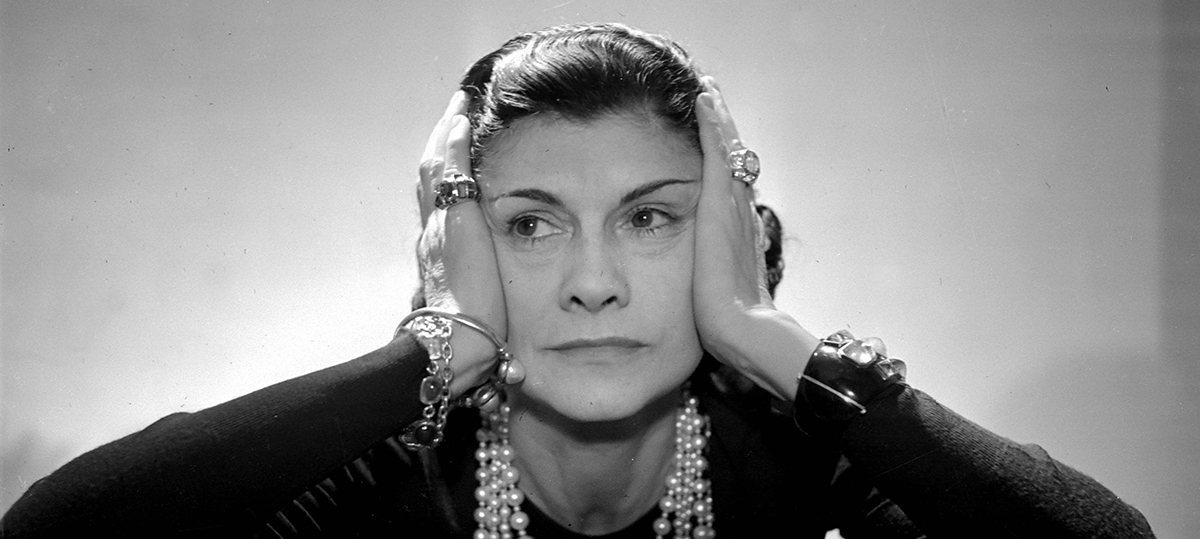


No such designer has had such an influence on how we dress than Chanel – a pioneer in an industry that was dominated by men, her style was revolutionary.
Borrowing from the wardrobes of her lovers, among them the Duke of Westminster (and if you are ever in the City of Westminster in London you can see his declaration of love with the iconic double C logo on the lampposts!), Chanel took trousers, tweeds, riding clothes and neck-ties, and cleverly transformed them into elegant women’s wear.
She released women from the constraints of previous designers with the freedom of men’s clothing without sacrificing the femininity.
Her Early Life
 A child of poverty she was sent to boarding school run by nuns: she noticed the soft fabrics, white collars, and floppy ties of the uniforms of the boys school next door, and the wimples and black gowns of the nuns. The stark rooms she lived in were adorned with bold crosses and crucifixes, which all feature in her later collections.
Coco learnt to sew at the orphanage; her first job was at a lingerie shop and she made extra money mending uniforms of the army offices from the garrison in town.
Whilst singing in a nightclub she met Etienne Balsan who asked her to join him at his country estate – he bred horses and regular visits to the race track exposed Coco to the “kept” women in the finest couture dresses and lavish hats and jewels.
Knowing that her small frame would be overwhelmed by these creations she set about by making pared-down clothes for herself.
Her simple hats that she created for herself moved away from the heavily feathered grand hats that the other ladies wore – they were smaller, and less embellished and started to create a stir; soon the famous “cocottes” were requesting her to design for them.
Chanel wore her hats with simple dresses, and even wore shirts, ties, jackets and jodhpurs from her male friends.
Her Early Work
In 1921 Coco met Arthur ‘Boy’ Capel who financed her first venture with a hat shop in Paris, in the Rue Cambon and then opened a second shop in Deauville.
Her classic cardigan style jacket was borrowed from ‘Boy’ – feeling the cold one day in Deauville she cut one of his woollen sweaters down the front, finishing the raw edge with ribbon and adding a collar and bow.
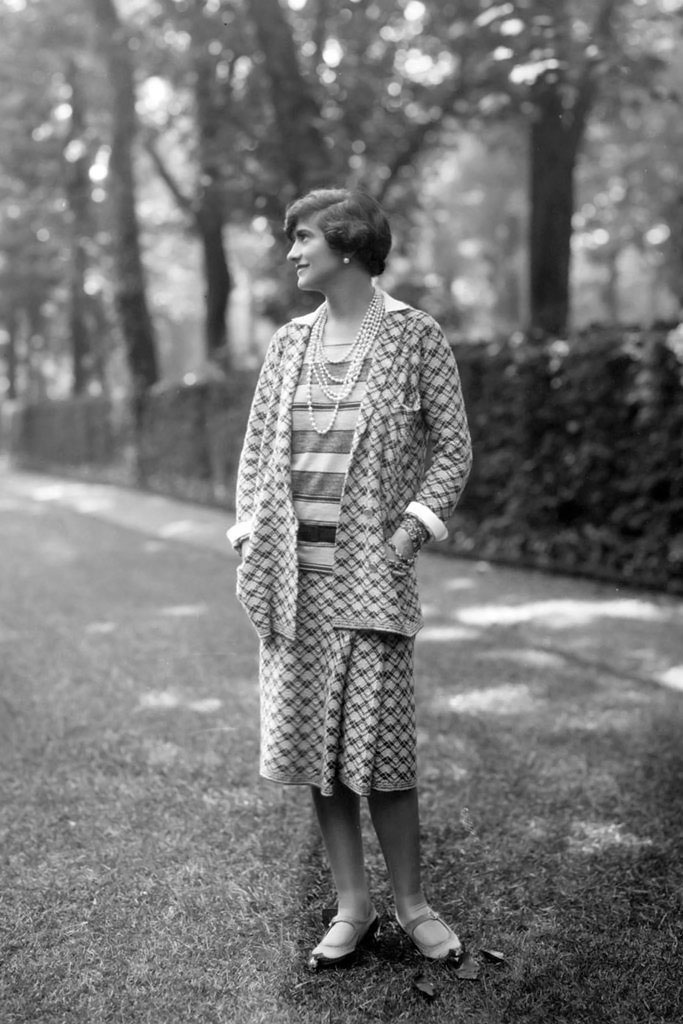
Practicality drove her style. The hand-knitted fabric was a far cry from the heavy fabrics and fancy taffetas that were popular at the time. Chanel’s jersey was fluid and moved as she did. She soon started making jackets and skirt ensembles.
The fabric was not as lightweight as she wanted, so when she was shown a machine made fabric by the textile firm Rodier (who were planning to use their
beige jersey for men’s under garments, but it hadn’t worked) Chanel secured it for a bargain price and set about designing simple elegant garments.
While other designers’ skirts were long and narrow, tight at the ankle, Chanel’s were loose, full and shorter. Her clothes made women feel young and sexy!
Establishing the brand

Her fashions were in demand by 1915 when she opened another branch in Biarritz, and on both sides of the Atlantic she was making news – American magazine Harper’s Bazaar feature her collections including, a safari jacket and skirt in jersey, fur trimmed coats and pocketed coats.
Chanel was fast becoming a leading example of the ‘new woman’, both in style and business, shedding her corset, cutting her hair short and tanning her face in the sun.
She put others in charge of her shops and moved back to Paris; with her work rooms overflowing she moved a few doors down from 21 to 31 Rue Cambon (where the shop still stands today) and made enough money to pay back the loan from Boy.
Rainy days in Paris compelled her to invent a rubberised style of coat based on the lines of the chauffeur with deep pockets, adjustable tabs at the cuff, not only in basic black and white, but rose and blue colours too.
Her Influences
Throughout her life Chanel took in the wardrobes of her lovers – from ‘Boy’, the riding habits and jodhpurs, and the jersey fabrics and the striped sweaters from the fishermen, from their trips to Deauville.
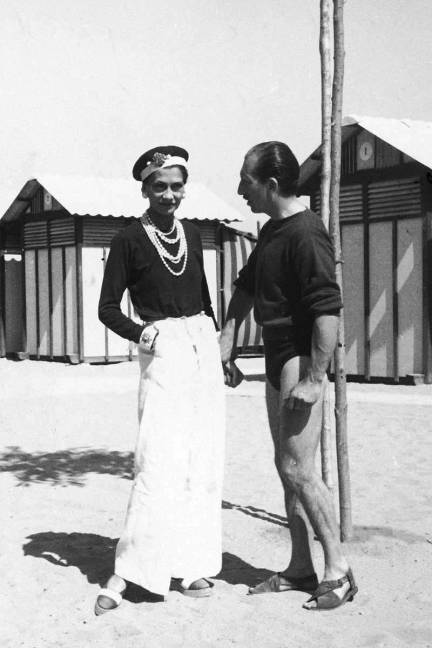
During her time with the Duke of Westminster she wore the quintessentially English country style. On a visit to the Duke’s tweed factories in Scotland she came up with the idea of using the rough rugged fabric for a jacket. Her life with the Duke was essential in creating the “Chanel identity”; it was during this time that Coco got the inspiration for her soft belted tweed jacket, blazers and cuff-linked shirts. On days out on his yacht she wore the Duke’s sweaters and trousers – not the normal attire for a woman.
Back in London, Chanel started to mix her simple elegant lines with statement accessories – layered strings of pearls, clusters of stones, and enamel bracelets – many of these pieces feature the crosses and crucifixes taken from her memories of the convent in her youth.
On embarking on an affair with Grand Duke Dimitri Pavlovich she met his sister who along with the Duke was in exile and need of funds – skilled in the art of embroidery she was hired by Chanel to recreate traditional Russian designs on coats and jackets. She soon started adding beading and pearls to the garments. As embroidery became more popular, more designs were copied from Oriental rugs and Chinese vases and a crocheted chenille hat was an
immediate hit.
Although the jersey remained a staple, the Russian look became so big that in addition to the designers, technicians in the work room increased to 50 seamstresses.
Parfums Chanel
Dimitri’s most important contribution was to introduce Coco to the chemist, Ernest Beaux. When she asked Beaux to create her a fragrance they went to work at his laboratory in Grasse. Mixing together over eighty florals, including the very expensive jasmine note and for the first time ever intensifying the natural scent with synthetic chemicals, Chanel No. 5 was born.
Chanel was a very astute business woman and knew that the scent would not sell itself so with her marketing skills she created simple modern bottles , again borrowed from the toiletry cases of her lovers.
Most significantly she put her name to the product, which no designer has done before. The fitting rooms and the salon on Rue Cambon were sprayed with the new scent. Small bottles of the perfume were handed out to her prominent friends; she produced a marketing coup – the first perfume samples!
The creation of Chanel No.5 would give her economic independence for the rest of her life.
Chanel closed her house at the outbreak of WWII and for several years lived in semi-retirement selling only No.5 and a few accessories from the boutique on Rue Cambon, but as she watched the new designers such as Christian Dior and Cristobal Balenciaga bringing back ornate and constricting styles she felt encouraged to design her simple lines once more.
A return to couture
In 1953, aged 70 she re-opened her house. A total of 350 work room staff were hired, fabrics were sourced and every one was personally selected by Coco. For daytime she once again turned to silk jersey, soft tweeds, wools, linens and silk; for evening she used laces, chiffons
and brocades.
For over a year she worked on the collection – the jackets had to be loose, hanging from the shoulder and the skirt had to move with ease, the pockets falling exactly right for the hands to slide in. The collection was ripped apart and re-done until it was perfect, making sure that the inside was just as perfect as the outside.
Then on February 5th, 1954 in the showroom at Rue Cambon she launched her new collection. Simple elegant designs in her signature black, white and beige graced the runway: jersey suits with patch pockets, school girl coats, large bows, shirtwaist dresses and for evening wear soft fluid dresses in silk jersey and brocades, very reminiscent of her first designs in the 20s and 30s.
The European press called her collection “melancholy and retrospective” and a “fiasco”. But if the French and the British were cruel and dismissive the Americans welcomed her back: “The Chanel look, as specific as H2O meant a combination of youth, comfort, jersey, pearls and luxury hidden away” said Vogue, and by her third collection Life magazine said “She influences everything. At 71 she is bringing more than a style – a revolution.”
Expanding her collection of accessories, she brought other ideas from the past and made them look new again. She used flowers for fabric pins and hair adornments. Her shoulder bag, created in the 30s was reintroduced in 1955 slimmed down and quilted in leather or jersey; this was the status symbol for the second half of the century.
The famous two-toned shoes popular in the 20s emerged with a new twist – low heel and sling back. Like everything else she did they were pretty and practical. The black toe makes the foot look smaller and the beige makes the leg appear longer.
In 1957 the renowned store Neiman Marcus invited her to receive an award as the most significant designer of the past 50 years.
Chanel’s genius as a fashion designer lies, not in her ability to make clothes that reflect social changes and shifting gender roles, but by drawing inspiration from her personal life. She created clothes she wanted to wear and in turn created simple, elegant and practical clothing that were desirable to other women.